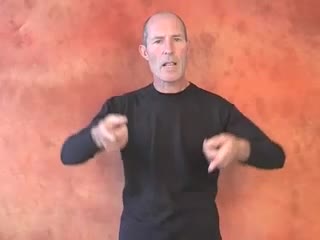
What This Sign Means in BSL
The BSL sign for settlement crack is wonderfully descriptive, painting a clear picture of what's happening within a structure. At its heart, this sign represents a specific type of fissure, one that forms due to the gradual shifting or 'settling' of a building's foundations or fabric. It's not just any crack; it carries the implicit meaning of structural movement, often a concern for property owners and builders alike.
You’ll notice how the dominant G-hand, with its extended index finger, acts like a tool or a visible line, tracing a path on or near the non-dominant flat B-hand. This B-hand often functions as a stand-in for a wall, floor, or any flat surface where a crack might appear. The movement itself – a downward, slightly jagged or linear motion – directly mimics the way a crack might appear and extend over time as a building settles under its own weight or external pressures.
This isn't a sign you'd use for a hairline fracture in a teacup, or a superficial scratch. It conveys a more serious implication of structural integrity. When you see or use this sign, it immediately brings to mind the context of buildings, foundations, and the natural, often slow, process of subsidence or compression that can lead to visible damage. It's precise, practical, and carries a subtle weight of potential concern.
When This Sign Feels Natural
You'll find yourself reaching for this sign in very specific, practical conversations. It feels most natural when discussing property, home maintenance, construction, or even during a property survey. Imagine you're chatting with a neighbour about their new extension, or explaining to a friend why you're holding off buying an older house; this sign would fit right in. It's an excellent piece of vocabulary for anyone involved in trades, architecture, surveying, or simply managing their own home.
The register for "settlement crack" is generally informative and factual. You might use it to alert someone to an issue, to describe a problem you've found, or to explain a structural concern. It wouldn't typically appear in highly emotional or abstract discussions. Your audience might be a builder, a landlord, a fellow homeowner, or a surveyor. It’s a sign that conveys tangible information about the physical world around us.
While you might have a more general sign for 'crack' or 'damage', choosing "settlement crack" tells your audience that you're referring to something specific – a crack with a cause directly related to the building's stability over time. If you're talking about a small, insignificant blemish, a simpler sign might suffice. But when the context demands precision about structural issues, this sign steps up to convey that particular nuance effectively.
What Learners Usually Miss
One common pitfall for learners is not fully capturing the 'settlement' aspect of the sign. They might get the 'crack' part right – the G-hand on the B-hand – but miss the subtle yet crucial downward trajectory. The dominant G-hand needs to trace a path that explicitly suggests gravity pulling something down, or a structure sinking. It's not just a horizontal or upward movement; the downward direction is fundamental to the meaning of 'settlement'.
Another area where learners often stumble is in the distinction between a quick, sharp movement for a general 'crack' and the slightly more deliberate, almost drawn-out movement for "settlement crack." Think about how a crack *forms* over time. It's usually a slow process. While the sign itself isn't slow-motion, it shouldn't be too abrupt. The tracing action should feel like the crack is *emerging* or *extending* rather than just appearing instantly. Maintain that steady, slightly jagged descent.
Finally, learners sometimes overlook the non-dominant B-hand's role. It's not just a passive surface; it's the 'wall' or 'ground' where the crack is occurring. Ensure your B-hand is held steady and firm, providing the context for the crack. If the B-hand is flimsy or moves too much, it detracts from the visual clarity. And don't forget your facial expression! A slight furrow of the brow or a look of mild concern can underscore the seriousness of a "settlement crack" compared to a mere superficial line.
A Simple Way to Remember It
To really embed this sign in your memory, think about it as literally drawing the problem onto a surface. The sign is highly iconic, showing you exactly what it means. Imagine you're pointing out a crack on a wall and tracing its path downwards, showing how it's developed due to the building's movement.
- The G-hand as the crack itself: Your extended index finger is literally drawing the line of the crack. It's the visible manifestation of the damage.
- The B-hand as the wall or surface: This flat hand is the foundation, the wall, or the ground where the crack is appearing. It provides the essential backdrop for the damage.
- The downward, jagged movement as 'settling': The action of the G-hand moving downwards conveys the idea of something sinking or settling under pressure, and the slight jaggedness hints at the irregular nature of a real-world crack.
Short Practice Situations
- My surveyor found a serious settlement crack in the foundation of the old building.
- They're worried about the growing settlement cracks in the basement wall of their new house.
- We need to get an expert to inspect these settlement cracks before buying the property.
- Is that just a superficial mark, or could it be a proper settlement crack caused by the ground shifting?
- After the heavy rains, several small settlement cracks became much more noticeable in the patio.
Signs to Learn Next
- CRACK (general): Learning the more general sign for 'crack' will help you understand the distinction between a specific structural issue and a simple break or fissure.
- DAMAGE: "Settlement crack" is a form of damage, so understanding the broader sign for 'damage' will place this specific sign within a wider semantic field.
- WALL / BUILDING: These contextual signs are essential. Often, when discussing a "settlement crack," you'll be referring to it on a 'wall' or within a 'building'.
- FOUNDATION: As settlement cracks often originate in the foundation, knowing this sign will allow for more detailed discussions about building integrity.
- REPAIR / FIX: Once a settlement crack is identified, the next step is often to 'repair' or 'fix' it. These signs naturally follow in conversation.